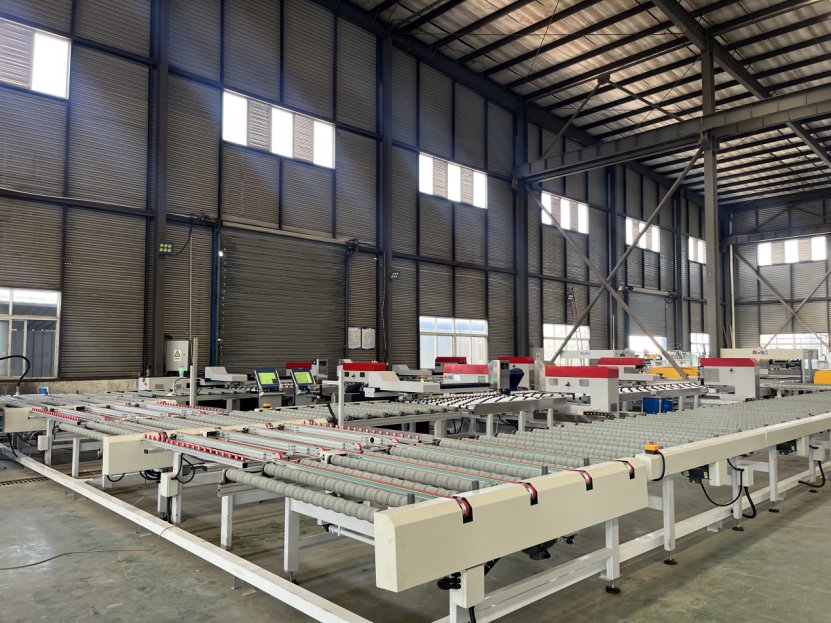
Start with the part, not the model. Three inputs decide the machine: the largest and smallest panel you must process, the hole drawing (diameters, positions, notches, polished edges), and the shape of your order book — long repeat runs or short mixed batches. With those three written down, the choice between a dedicated shower glass drilling machine, a drilling-and-milling centre and a linked production line becomes a short technical check rather than a sales conversation.
Why shower door work is a separate selection problem
Shower door panels look simple, but they are one of the more awkward parts in glass processing. A single panel may need hinge holes, handle holes, slots and shaped notches, and finished edges. The hole pattern changes with every door design, and the glass is often handled in small batches because each customer orders a different size and layout. That combination — many hole patterns, frequent changeover, moderate panel size — is what makes a machine right or wrong for this work.
Buyers often start by asking which machine is fastest. The more useful first question is: how often will I change the programme, and how much of the panel is actually drilled? A machine set up for long runs of one pattern is a poor fit for a shop that changes drawings several times a shift, even if its cycle time looks better on paper.
In North American markets these parts are usually called shower door glass; in many catalogues and in BLM's own documents the same work is called shower glass or shower enclosure glass. Both terms describe the same buying problem, so this guide uses them together.
Step 1 — Gate the panel size first
Write down the maximum panel, the minimum panel and the glass thickness range. Maximum size is the figure most often quoted, but minimum size is the one that causes surprises: a machine that handles a 2500 × 1500 mm panel may still not clamp or reference a narrow 1600 × 300 mm strip correctly.
For the A66 shower glass drilling machine, the customer draft specification and the printed catalog give the following figures. They are useful for an initial feasibility check, not as a signed specification:
| Check | Draft value | Why it matters |
|---|---|---|
| Maximum glass size | 2500 × 1500 mm Pending spec confirmation | Sets the largest door panel and whether two panels can be nested |
| Minimum glass size | 1600 × 300 mm Pending spec confirmation | Small strips, side panels and narrow returns |
| Processing range | X 0–2500 mm / Y1, Y2 0–1100 mm Pending spec confirmation | Whether the holes in your drawing fall inside the working envelope |
| Glass thickness | 4–19 mm Pending spec confirmation | Covers common shower door thicknesses; confirm your actual range |
| Drilling diameter | Φ6–Φ50 mm Pending spec confirmation | Hinge and handle hardware diameters |
| Table height | 900 ± 20 mm Pending spec confirmation | Matching height if you link to a conveyor or washing machine |
| Overall size | 5700 × 4800 × 1660 mm Pending spec confirmation | Floor planning including infeed, outfeed and service access |
If your largest panel does not fit, the answer is not "a bigger version of the same machine". Move to the CNC glass drilling machine range and check vertical or large-format platforms such as the A71X or A98 instead. If your smallest panel does not fit, ask for a clamping and referencing drawing before you commit — this is a project-specific question, not a catalog question.
Terminology note. "Hinge hole", "handle hole" and "handle cut-out" are common industry descriptions of shower door parts. BLM has not yet supplied a signed list of standard workpieces for its machines, so treat these as examples of what to put in your enquiry, not as a published capability list. Pending spec confirmation
Step 2 — Read the hole drawing as a specification
Take one representative drawing and count three things:
1. How many distinct hole diameters appear. If a panel uses two or three diameters and you change designs often, tool changing becomes the bottleneck. A rotary tool magazine or multiple spindles matter more than nominal spindle speed. 2. Whether any feature needs milling or polishing, not just drilling. Handle cut-outs, shaped notches and polished edges move the requirement from a drilling machine to a drilling-and-milling centre. Customer drafts mention an optional milling cutter that combines drilling, milling and polishing Pending spec confirmation — ask whether it is standard or optional for the exact build you are quoted. 3. Where the holes sit relative to the edge. Edge-distance limits and the minimum spacing between two simultaneous spindles are physical constraints. They are also the details most often missing from an enquiry, which is why suppliers quote a machine that later turns out to need a second pass.
The A66 draft describes a 2+2 spindle shower glass drilling machine; the A98 draft describes an 8+8 multi-spindle machine with a rotary tool magazine that can hold different drill-bit types at once. These are different answers to different hole-pattern problems: one is a dedicated batch drilling machine, the other is built for mixed specifications and scattered orders.
Send these five things with your hole drawing
- One representative DXF or dimensioned drawing, with the hole table
- Glass thickness and tolerance you work to
- Number of distinct hole diameters per panel
- Whether edges need milling, polishing or only drilling
- How many different drawings you run per shift
Step 3 — Match the machine to your order book
The same panel can be produced on three different configurations. What separates them is the order mix:
| Your situation | Configuration to investigate | Reason |
|---|---|---|
| Repetitive batches of one or two door designs | Dedicated shower glass drilling machine, e.g. A66 | Short programmes, minimal changeover, simplest operation |
| Many sizes and hole patterns per shift, mixed orders | Multi-spindle CNC with tool magazine, e.g. A98 or a vertical drilling and milling centre | Diameter changes happen inside the programme instead of at the tool change |
| Drilling is one station in a longer line | Shower door glass processing line with conveying, washing and handling | The constraint is material flow, not the drilling cycle |
There is a fourth case worth naming: when you should not buy a stand-alone machine at all. If operators already move every panel by hand from drilling to washing, and your volume is rising, a faster drilling machine will simply move the queue downstream. In that case the useful document is a line layout, not a machine quotation.
Several BLM case pages show shower glass drilling lines built around A31D, A66, A82 and A83 machines. They are useful as examples of how drilling is connected to conveying and washing, but they are project photographs, not performance guarantees: the published case texts contain no cycle-time, yield or accuracy figures.
Have a shower door drawing to review?
Send the panel size, thickness and hole drawing. Two required fields — everything else is optional, and our engineers will come back with a machine configuration rather than a price list.
Request a Project QuoteWhatsApp insteadFour mistakes that cost the most to fix later
Buying on maximum glass size alone. The working envelope, minimum panel, clamping method and edge distances decide whether your real parts fit. Ask for the processing range, not just the headline dimension.
Assuming "optional" means "included". Customer drafts mention optional milling cutters, barcode readers, DXF import and ERP connection Pending spec confirmation. None of the supplied documents defines a standard configuration, so the quotation must list standard and optional equipment separately — in writing.
Ignoring changeover. If drawings change ten times a shift, a machine with fast drilling but manual tool changes will underperform a slower machine with a tool magazine. Ask how a new hole pattern reaches the machine: manual entry, DXF import, or barcode-driven programme selection.
Forgetting the hand-off. Table height (900 ± 20 mm in the draft Pending spec confirmation), conveyor direction and the washing machine inlet height have to agree with the equipment you already own. This is the subject of the line integration guide and the most common source of installation rework.
How this guide connects to the rest of the buying process
Once the workpiece is defined, the next decision is the machine orientation, which is driven by your floor layout and the equipment already in the line: Vertical vs. Horizontal Glass Drilling Machines. If budget approval is the current blocker, read How Much Does a CNC Glass Drilling Machine Cost? for the variables that move a quotation. If the drilling station will be inserted into an existing line, go straight to How to Integrate CNC Glass Drilling into an Existing Line.
FAQ
What size CNC glass drilling machine do I need for shower doors?
Start from your largest and smallest panel and the position of the holes, not from a model name. As a first check, the A66 draft lists a 2500 × 1500 mm maximum panel and a 1600 × 300 mm minimum Pending spec confirmation. Confirm the working envelope and clamping method against your own drawing before selecting a machine.
Can one machine drill hinge holes and handle cut-outs?
Holes are drilled; handle cut-outs and shaped notches usually need milling, and a polished edge needs a polishing step. Whether one machine does all three depends on the build — customer drafts describe an optional milling cutter for drilling, milling and polishing Pending spec confirmation. Ask for the operation list of the exact configuration you are quoted.
How do mixed small orders change the choice?
Frequent drawings changes make tool changing the real constraint. A multi-spindle machine with a rotary tool magazine, or a programme fed by DXF or barcode, suits scattered orders better than a machine optimised for one repeating pattern. The A98 is the BLM example of this configuration.
Do I need a whole production line, or just a machine?
If drilling is followed by washing, edging or handling that already works at your current volume, a stand-alone machine is usually enough. If panels queue between stations or are moved manually several times, price the processing line as a project. The dividing line is material flow, not output alone.
Draft figures marked “Pending spec confirmation” come from BLM product documents and are replaced by a signed specification sheet before publication. BLM does not publish unrecorded performance or pricing data.